
Tumbling Media Comparison Guide: Ceramic, Plastic, Steel, and Organic
If you’ve ever spent time troubleshooting a vibratory finishing process that just isn’t delivering the results you need, you already know that the media you’re running is the engine of the whole process. Get it right, and you’re hitting your Ra targets, running efficient cycle times, and putting out consistent parts lot after lot. Get it wrong, and you’re dealing with impingement damage on soft aluminum, clogged recesses on complex geometries, or a burnished surface when you needed aggressive deburring.
The challenge is that tumbling media selection is complicated, more so than most consumable decisions in manufacturing. The type, shape, density, size, and compound all interact with each other and with your parts. Two media types can look similar on a spec sheet and perform very differently in practice.
This guide walks through the four main categories of vibratory tumbling media (ceramic, plastic and synthetic, steel, and organic), covering where each one excels, where it falls short, and the specific application factors that should drive your selection.
What Makes Tumbling Media Selection So Complex?
Every tumbling media decision comes down to three variables: type, shape, and size. Those three factors have to align with your workpiece material, part geometry, desired surface finish, production volume, and equipment setup. Change one variable, and the whole equation shifts.
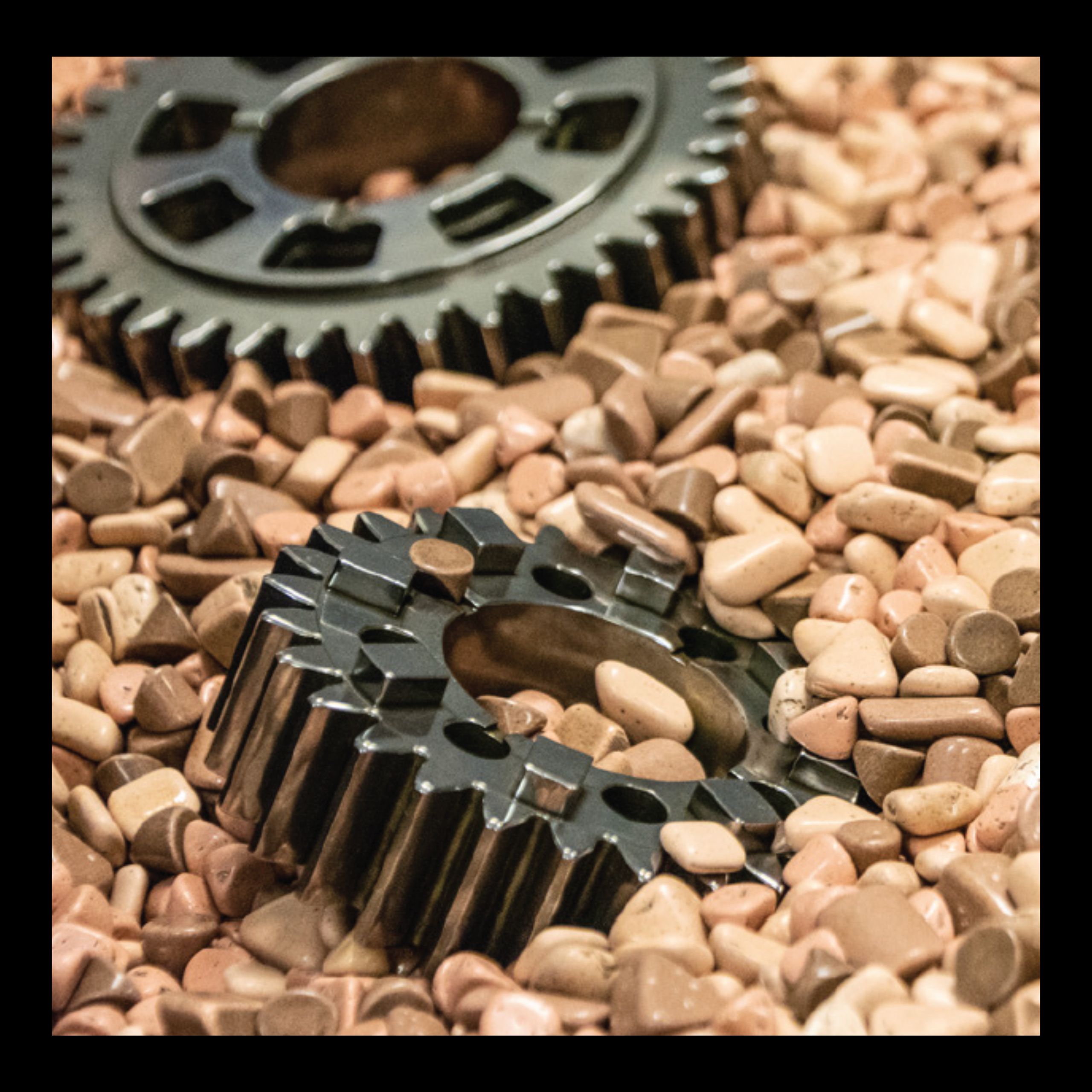
Take shape, for example. Ceramic media alone is available in triangles (straight cut, angle cut, and rounded), cylinders, tri-cylinders, ellipses, arrowheads, wedges, pyramids, tetrahedrons, cones, and balls, and that’s before you even get to size. Smaller media (think 3-6mm) reaches into tight recesses and works complex geometry. Larger media (20-30mm and up) provides more mass, more aggressive cutting action, and works well on bigger, simpler parts. The wrong shape for your geometry means unfinished areas, media lodging, or inconsistent contact. None of which you want to discover mid-production run.
And then there’s compound. Media doesn’t work alone. The compound keeps your parts clean, keeps the media clean, and lubricates the mass as it moves through the machine. Burnishing and polishing without the right compound pairing simply won’t get you where you need to go. So when we talk about selecting media, we’re really talking about selecting a system.
That’s why the best processes are often developed through careful trial, testing, and iteration rather than a single confident selection from a catalog. Here’s what you need to know about each media type.
Tumbling Media Comparison Guide: The Four Main Types
Ceramic Media
Ceramic is the most widely used vibratory media in the industry. It’s a general-purpose workhorse that handles a broad range of applications, from aggressive deburring on cast iron components to polishing aerospace turbine blades. If you’re running steel, stainless, high-temperature alloys, or harder metals, ceramic is almost always in the conversation.
What gives ceramic its versatility is the range of formulations available. Most ceramic media uses aluminum oxide grain mixed into the composition to provide the cutting characteristics, but the formulations vary significantly from there. You’ll find:
- Fast-cutting formulations for aggressive deburring and material removal
- Medium-cutting for standard deburring and edge radiusing
- Light-cutting for cleaning and mild surface improvement
- Non-abrasive burnishing for achieving a bright, compressed surface without cutting
Density is another lever. Ceramic media spans a wide range, from ultra-lightweight formulations around 65 lbs per cubic foot up to high-density options at 130 lbs per cubic foot. Higher density means more mass per piece, which translates to more pressure on the workpiece and more aggressive action. For general-purpose polishing and deburring on steel, stainless, and aluminum parts, mid-range densities are common. For harder alloys or demanding aerospace applications, you often want that higher density.
Industries that rely heavily on ceramic media: aerospace finishing, medical and dental implant manufacturing, jet engine and turbine blade finishing, firearms, orthopedic applications, additive manufacturing post-processing, and general machined and cast part deburring.
Where ceramic has limitations: On very soft metals like aluminum alloys with thin walls, delicate zinc die castings, or fine jewelry components, ceramic can cause surface impingement even with lighter formulations. That’s where plastic media becomes the better answer.
Plastic and Synthetic Media
Plastic and synthetic media exists largely because ceramic, for all its versatility, can be too aggressive for softer materials. If you’re finishing aluminum, zinc, or brass, especially die-cast workpieces, plastic media delivers the finishing action you need without beating up your parts.
The physics here are straightforward. Plastic media has a lower bulk density than ceramic, so the pressure it exerts on the workpiece is less. That means you can run aluminum components through a vibratory process and come out with clean, deburred, uniformly finished parts without the surface damage that heavier ceramic would leave behind.
Some of the most common use cases for plastic and synthetic media include:
- Pre-plate and pre-anodize finishing: where you need a uniform, clean surface before secondary operations and any surface imperfections will telegraph through the coating
- Pre-paint finishing: same principle; you want consistent surface prep across every part
- Die-cast finishing: aluminum and zinc die castings are a natural fit for plastic media given the material sensitivity
- Blending machine lines on aluminum: plastic media smooths out tooling marks and machining artifacts without altering surface dimensions
- Jewelry finishing for precious metals: before buffing, plastic media provides a fine, uniform base finish
The jewelry industry in particular leans on plastic and synthetic media because it provides control. With gold, silver, and other precious metals, you don’t have the material tolerance for an aggressive process.
One thing to keep in mind: plastic media’s gentler action means it takes longer to accomplish what ceramic might do in fewer cycles. If cycle time is your primary constraint, plastic media may not be the fastest path. But if part integrity and finish quality are non-negotiable, that tradeoff is almost always worth it.
Steel and Stainless Steel Media
Steel media operates on a completely different principle than ceramic or plastic. While those media types work through abrasive cutting, steel media burnishes. It compresses and polishes the surface rather than cutting into it. If you’ve ever seen parts come out of a ball burnishing process with that deep, almost mirror-like luster, that’s what steel media delivers.
The effect comes from density. Steel media runs at roughly 300 lbs per cubic foot, significantly heavier than ceramic or plastic. That weight generates the pressure required to produce the high-luster finish steel media is known for. It’s essentially peening the surface, creating a compressed, bright, cosmetically appealing result.
Steel media is available in both carbon steel and stainless steel options. Stainless is preferred when contamination is a concern, particularly on aluminum or brass components where carbon steel particles could leave rust staining over time.
Where steel media performs best:
- Ball burnishing and polishing: the signature application; produces a high-luster, almost plated appearance
- Cleaning operations: both new parts and refurbishment work benefit from steel media’s ability to thoroughly clean and brighten surfaces
- Pre-anodize brightening: components intended for anodizing often benefit from a burnishing pass to create a uniform, bright base
- Light deburring: steel media doesn’t have the cutting ability of ceramic, but it can handle light edge work
There are a few important considerations specific to steel media:
Equipment Compatibility
Because of its high bulk density, not every vibratory bowl or tub can handle steel media. The equipment needs to be robust enough to turn the mass, and the mass is heavy at approximately 300 lbs per cubic foot. If you run steel media in equipment that isn’t rated for it, you’re shortening the life of the machine and creating a safety risk.
Compound Selection
With steel media, the compound plays an even bigger role than in ceramic applications. Getting the compound wrong here usually means a disappointing finish or, worse, staining on the parts.
Maintenance and Housekeeping
Steel media does last a long time with proper care, but it requires attention. Carbon steel media in particular needs to be stored and processed carefully to prevent rust from contaminating your parts and your process.
Organic Media: Corn Cob and Walnut Shell
Organic media, such as crushed corn cob and walnut shell, play a specific and narrow role in most finishing operations. These are lightweight, natural materials, and that characteristic is both their biggest advantage and their main limitation.
You won’t typically use organic media for primary deburring or polishing. Where it shines is in the steps surrounding the main process. The most common application is drying parts after vibratory processing. After parts come out of a wet vibratory process, they need to be dried quickly and completely to prevent corrosion. Corn cob in particular excels here. Its water absorption capacity is excellent, and it also picks up compound residue and media dust that would otherwise remain on the part surface.
Walnut shell is a step up in terms of light polishing action. It’s used for polishing soft alloys and jewelry, often as a finishing pass to bring out a bit more luster before parts move to the next stage. In jewelry manufacturing, a walnut shell tumble after a plastic media process can add a final warmth and sheen to the surface.
Crushed corn cob is also popular in firearms applications, cleaning parts, removing residue, and leaving a clean, dry surface before inspection or assembly.
The honest assessment: organic media is a supporting player. If you’re evaluating whether to add it to your process, the question isn’t whether it can handle your primary finishing work (it can’t), but whether the drying and cleaning step it handles is creating problems in your current process. Corrosion, residue, spotted parts coming out of the vibratory cycle. If so, organic media is a straightforward, cost-effective solution.
How to Match Media to Your Application
Every media selection comes down to five factors. Work through these before committing to a process.
- Workpiece material is the first filter. Harder metals like steel and high-temperature alloys point to ceramic. Soft non-ferrous metals like aluminum, zinc, and brass call for plastic, with steel burnishing as a secondary option depending on the finish goal.
- Part geometry determines what shapes and sizes are even viable. Complex parts with blind holes, deep recesses, or thin walls require media small enough to reach the surface and shaped to avoid lodging. A 20mm cylinder isn’t getting into a 6mm blind hole.
- Desired finish outcome narrows the field further. Deburring, polishing, burnishing, and cleaning each point toward different media types. Multi-stage processes are common when a single media can’t get you all the way to spec.
- Cycle time and production volume affect the cost-per-part math. Ceramic offers excellent durability for high-volume runs; plastic wear rates vary by formulation; steel lasts a long time with proper maintenance. Prototype economics look different than 24/7 production.
- Equipment compatibility is non-negotiable. Steel media requires a machine robust enough to handle its bulk density. Heavier ceramic formulations may need specific vibratory settings. Know your equipment’s limits before selecting media that may push past them.
Ready to Narrow It Down?
Choosing the right vibratory tumbling media is one of those decisions where the details really do matter, and where the right guidance at the start of the process saves significant time and cost down the road. For straightforward applications, the information above will take you a long way. But for tight Ra targets, complex geometries, or multi-stage processes on sensitive materials, the right answer often requires process development, testing, and iteration with someone who has run similar parts before.
That’s exactly what our team and process development labs are here for. If you’re working through a media selection for a new application, troubleshooting an existing process, or looking to improve consistency on your production floor, we’ll dig into the specifics with you, run sample parts, test media and compound combinations, and help you build a validated, repeatable process before you commit to full production. Contact us today to connect with a finishing specialist.